Daily Meditation Recordings, with Nirmala Werner – Week of Apr 29 – 3 May, 2024
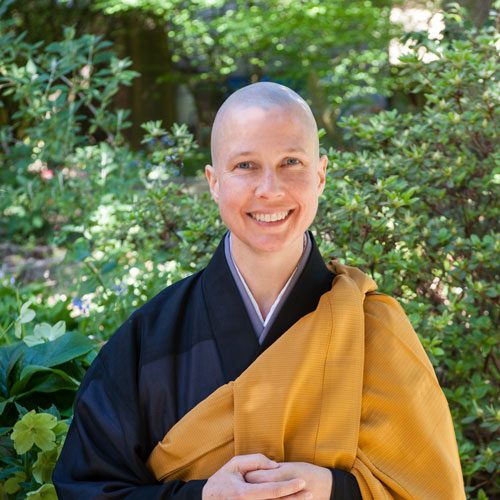
Nirmala Werner
We’re fortunate that Nirmala Werner has generously offered to lead our daily meditation sessions. To find out more about Nirmala, and to view her other contributions to Sangha Live, click here. Recordings will be posted by the end of the day of the live session.
This week’s topic is “Mindfulness of the nervous system: transforming fear, struggle and separation into love and connection“.
We humans are social animals and need each other to feel safe and secure, to grow and to nourish ourselves. How can we live with a sense of connection, loving-kindness, and inner family?
Our meditation practice allows us to take a break between stimulus and response. When we come into contact with our loved ones, we all too easily lose the inner freedom we think we have achieved and avoid our difficulties, also called spiritual bypassing.
This week we explore what supports us to react flexibly to the internal and external world, to relax and to allow closeness and real intimacy. We will look into the first foundation of mindfulness, mindfulness of the body, including harmonizing the body formations and nervous system to meet our difficulties with gentleness.

This week’s topic is “The Changeless. Knock, knock on Heaven’s Door”. Conventional human experience reveals the subject and the object. The object includes, mind/body/things/world/time/space and here and now. All of these are subject to change. The subject includes consciousness, perception, awareness, attention, mindfulness, I and my. All subject to change. We might conclude true reality reveals change. Can realisation of the changeless make easy the navigation of change?
This week’s topic is The Freedom of an Unassuming Mind.
The Buddha used the image of a tangled and knotted thread to represent the complex roots of human suffering and distress. It takes sensitivity, persistence, and care to disentangle the tangle of ‘dukkha’. A tricky part of this is that our assumptions about the world radically shape the way the world appears, while remaining quite hidden to us. Fortunately, wisdom teachings and practices bring assumptions into view and support the untying of these unseen knots, opening us into a wide and free existence.
Dharma teachings point to how dangerous and destructive anger is, and how words and actions can cause great suffering. This class looks at skilful means for meeting and exploring anger, and for understanding and transforming it. Martin leads a specially oriented meditation, and his talk explores the inner strength and confidence which can arise from…
Consciousness itself is not disturbed by a busy mind. In practice, the ego takes this truth and says, “I will transcend mind.” But the “I” that experiences itself as separate from life cannot and will not ever know liberation. There is no such thing as an enlightened ego. What else is possible? Resting in Love,…
What brings you joy? How does joy affect you? What is your relationship to joy? Experiencing joys, small and large, helps keep us connected to what is meaningful, nourishing, and enlivening. Come explore the many aspects of dharma joy as an intentional everyday practice, and how it informs and supports not only your own well-being,…
With the fragile condition of our eco-system finally breaking through into the mainstream news cycle, we can easily be overwhelmed by the loss of biodiversity and permafrost, the pollution of earth, air and oceans, and the attendant insecurity and danger to life on earth. We might struggle both with the information itself – the amount,…
What do sitting on the meditation cushion and running have in common? How might this form of movement be included in our mindfulness practice? Brian Dean Williams, both an insight meditation teacher and an avid trail runner, explored this with us at our weekly Sunday session.
If there is one practice that defines the quality of the Buddha’s teachings, it is right view. This is a wisdom path. Right view is the beginning and ending of the path. Right view comes first among the eight path factors because it is needed for the entire path. Right view can be described as…